General patient information, not a diagnosis or treatment recommendation. A dentist needs to assess your individual situation.
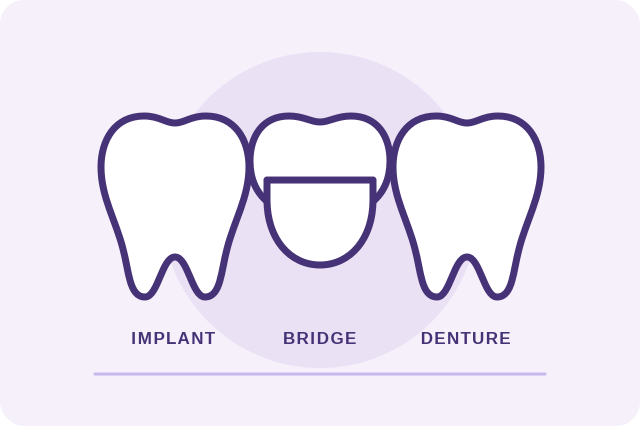
Missing teeth can affect eating, speaking and how you feel about your smile. Dental implants, bridges and dentures can all replace missing teeth, but they work in different ways. The right option depends on which teeth are missing, the health of your remaining teeth and gums, your jawbone, your general health, your preferences and your budget.
This guide gives you a starting point for a conversation with a dentist. It cannot tell you which treatment is suitable for you.
The three options in plain English
Dental implants
A dental implant is a small support, usually made from titanium, that is placed in the jawbone where a tooth root was. A crown, bridge or denture is then attached to the implant.
Implants can replace one tooth, support several connected replacement teeth or help hold a denture in place. Treatment involves surgery and usually takes place in stages. Your dentist needs to assess your mouth, jawbone, health and medicines before advising whether implants may be suitable.
Implant placement is commonly performed using local anaesthetic, which numbs the treatment area while you remain awake. Some practices offer general anaesthesia as an option for implant surgery, particularly for more complex treatment.
Dental bridges
A dental bridge is a fixed replacement for one or more missing teeth. A traditional bridge uses teeth beside the gap for support. These supporting teeth are usually reshaped and covered with crowns that connect to the replacement tooth or teeth. Other bridge designs may bond to the back of nearby teeth or be supported by implants.
A bridge stays in your mouth and is not removed for daily cleaning. The health and strength of the supporting teeth matter, and you need to clean beneath the replacement tooth as well as around the supporting teeth.
Dentures
Dentures are removable replacement teeth. A partial denture replaces some missing teeth and usually gains support from the remaining teeth and gums. A full denture replaces all teeth in the upper or lower jaw. Some dentures can also attach to implants for added support.
Dentures are custom-made and may take several appointments to fit. They need to be removed and cleaned as directed. Their fit can change over time, particularly after teeth are removed and the mouth heals, so adjustments, relining or replacement may be needed.
Dental implants, bridges and dentures at a glance
| Question | Dental implants | Dental bridges | Dentures |
|---|---|---|---|
| How are they supported? | By implants placed in the jawbone | Usually by nearby teeth; some bridges are supported by implants | By the gums and remaining teeth; some dentures attach to implants |
| Fixed or removable? | The implant stays in place. The attached crown or bridge is usually fixed; an implant-retained denture may be removable | Usually fixed | Removable |
| Is surgery involved? | Yes, to place the implant. Local anaesthetic is commonly used; IV sedation or general anaesthesia may be used where appropriate | Usually no surgery for a tooth-supported bridge; implant-supported bridges involve implant surgery | Usually no surgery to make the denture, although extractions or implants may be part of a broader plan |
| What happens to nearby teeth? | A single implant can replace a tooth without reshaping neighbouring teeth | Traditional bridges usually require supporting teeth to be reshaped | Partial dentures may use clasps or other components around remaining teeth |
| How long can treatment take? | Commonly several stages over a number of months, depending on healing and any additional procedures | Commonly more than one appointment, with laboratory work between visits | Commonly several appointments for measurements, trial stages, fitting and adjustments |
| What does daily care involve? | Cleaning around the implant and beneath any connected teeth, plus regular professional checks | Brushing and cleaning beneath the bridge with the method shown by the dental team | Removing and cleaning the denture, cleaning the mouth and remaining teeth, and following advice about overnight wear |
| What may need attention later? | The implant, surrounding tissues, connector or replacement teeth can develop problems and need review or repair | Supporting teeth can develop decay or other problems; the bridge can loosen, chip or need replacement | Fit can change; the denture can wear, break or need adjustment, relining or replacement |
| How do costs generally compare? | Often a higher initial outlay: planning, surgery, implant components and replacement teeth may be separate items | Depends on design, materials and number of replacement teeth; ask whether supporting crowns and lab work are included | Often a lower initial outlay than fixed implant treatment; adjustments, relining and replacement may add later costs |
These are general differences. For example, an implant-supported bridge differs from a bridge supported by natural teeth, and an implant-retained denture combines features of implants and removable dentures.
Indicative costs: what changes the comparison?
There is no standard fee for private dental treatment in Australia. Fees vary by clinic, location, materials and the work required, so broad dollar ranges can give a misleading impression of what a complete plan will cost. Healthdirect recommends asking the treating dental professional for the cost, and the Australian Dental Association’s fee survey is a dated snapshot of common item fees rather than a quote for a complete implant, bridge or denture plan.
As a broad guide, a conventional removable denture often has a lower initial cost; a tooth-supported bridge is priced around its design, supporting teeth and replacement units; and an implant plan commonly has more separate stages and components, which can increase the initial total. Replacing several or all teeth changes the comparison substantially. Imaging, extractions, gum treatment, bone grafting, temporary teeth, sedation and future maintenance may be additional. Ask for an itemised quote that states what is included, what may be charged separately and the likely total for the proposed course of care. These patterns are for comparing questions to ask, not a price estimate or recommendation.
What might make one option worth discussing?
Looking for a free implant consultation?
Find an implant consultationQuestions to ask when replacing one, several or all teeth
- What options could suit this specific gap or pattern of missing teeth, and what are their advantages and disadvantages for me?
- If several teeth or a full arch are involved, can a bridge or denture replace more than one tooth without placing an implant for each tooth?
- Which remaining teeth are healthy enough to support a bridge, and what preparation would that involve?
- What are the surgical, healing and maintenance implications of an implant-supported option?
- What would each option cost as a complete plan, including temporary teeth, additional procedures and follow-up?
- What could change the recommendation or the final cost after scans or further assessment?
You may want to ask about implants if:
- you want a fixed replacement and would prefer not to prepare healthy neighbouring teeth
- you are willing to consider surgery and a staged treatment process
- your dentist considers your jawbone, gums and general health suitable
- you can commit to daily cleaning and ongoing reviews
Implants are not guaranteed to last for life. They can fail, and inflammation can develop in the tissues around them. Ask your dentist to explain your individual risks and what would happen if an implant or the attached tooth developed a problem.
You may want to ask about a bridge if:
- you want a fixed option for one or more gaps
- the teeth beside the gap may be suitable to support a bridge
- you would prefer to avoid implant surgery
- you are comfortable with the effect the proposed design may have on supporting teeth
Not every bridge needs the same amount of tooth preparation. Ask which design is being proposed, why it suits the position of the gap and how you will clean beneath it.
You may want to ask about dentures if:
- you need to replace several or all missing teeth
- you want a removable option
- you want to compare a more affordable initial option
- you need a temporary replacement while your mouth heals or while another treatment is planned
Dentures can take time to get used to. Fit, speaking and eating may feel different at first. If a denture becomes loose, painful or damaged, have it assessed rather than trying to adjust it yourself.
The comparison depends on your starting point
Replacing one missing tooth is a different decision from replacing several teeth or a complete arch. Before comparing treatment names, ask the dentist to explain:
- which teeth can be kept and whether any teeth are expected to need treatment or removal
- what will support the replacement teeth
- whether the result will be fixed or removable
- what you will wear while treatment or healing is underway
- how you will clean the final design
- what maintenance, repairs or replacement may be needed later
There may also be a reasonable option to monitor or leave a gap in some circumstances. A dentist can explain how that could affect your bite, eating and surrounding teeth.
Compare the whole treatment plan and quote
A headline fee does not always describe the full course of treatment. Ask for a written plan that identifies what is included and what may be charged separately.
Useful questions include:
- Which options could reasonably meet my needs, and why are you recommending this one?
- What are the benefits, limitations and risks for me?
- Which natural teeth can be kept?
- Will I need X-rays, scans, extractions, bone treatment or treatment for my gums first?
- What temporary teeth will I have during treatment or healing?
- What type of anaesthetic or sedation is proposed, who will provide it, and what are its risks and separate costs?
- How many appointments are expected, and over what period?
- Can you show me how I would clean this option every day?
- What parts of the assessment, treatment, replacement teeth and follow-up are included in the quote?
- What could change the final cost?
- What maintenance, repairs or future replacement should I plan for?
You can take time to consider the plan, ask for clarification and seek another opinion before agreeing to treatment.
Take the next step
A dental consultation can help you compare options for your own mouth. The dentist may examine your teeth and gums and recommend X-rays or scans before explaining which treatments may be suitable.
Enquire with Dental Match to tell us what you are exploring. We will confirm receipt of your enquiry, and our team will call you directly about next steps and suitable participating clinics. Treatment recommendations, risks and fees come from the treating dentist after an individual assessment.
Sources and further reading
- healthdirect — Dental implant procedure
- healthdirect — General anaesthetic
- Australian Society of Anaesthetists — Anaesthesia for oral surgery
- healthdirect — Dental bridge
- Australian Dental Association — Crowns, bridges and veneers
- Australian Dental Association — Dentures
- healthdirect — Cost of dental care
- Australian Dental Association — Dental Fees Survey 2022
Rules and guidance can change. Check the linked source before relying on information for a decision.