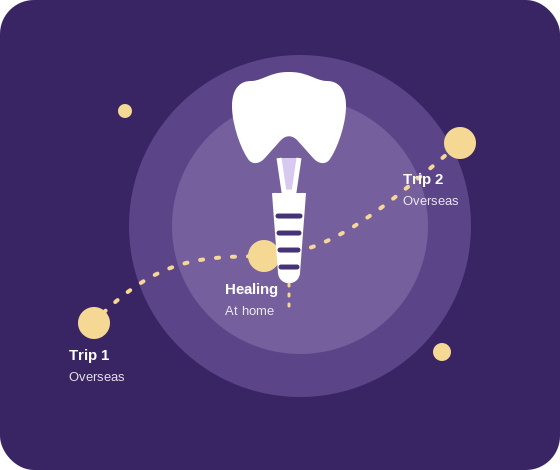
Getting dental implants overseas is often advertised with a low upfront fee, but flights, healing time between visits and follow-up care can narrow the savings, often making implants cheaper in Australia. Many patients do not realise they may need to make multiple overseas trips during implant treatment, which can increase costs substantially.
This guide sets out the real advantages, the full costs and the risks, so you can compare an overseas quote with local options on equal terms.
The short answer
Going overseas may save money on a straightforward case, but only if you budget and plan for the whole treatment.
It may suit you if:
- You need one or two implants, not a full set of teeth.
- Your teeth and gums are otherwise healthy and you don’t need a bone graft.
- You can stay through the healing period or make two trips, with money set aside in case something goes wrong.
- You’ve checked the clinic carefully and have a dentist at home to look after the implant afterwards.
Think twice if:
- You care about having direct, immediate access to your dentist if there is a complication.
- You need full-arch treatment, a bone graft or a sinus lift.
- You have untreated gum disease, which can raise the risk of implant failure and means you’ll need more frequent check-ups.
- You can only take a week or so off work.
- Your budget has no room for a second trip or repair work.
Key risks to weigh
The biggest risks tend to show up after you’re home, when the clinic that did the work is far away.
Follow-up and complications
Dentists report seeing poorly fitted work, infections, implant failure and the need for corrective procedures after treatment abroad [4]. In a 2022 survey of 1,000 UK dentists, most of those who had seen patients treated abroad had needed to fix problems, implants were the second most common work needing follow-up, and half put repairs at more than AUD 1,500 [3].
Implants also need care for life. If a dentist at home can’t identify the implant brand, repairs and complications are harder to manage [11], and a major review put the rate of peri-implantitis, gum inflammation with bone loss around an implant, at about 22% [12].
Standards and regulation
Healthcare standards and infection-control practices vary between countries. In some lower-income countries, minimum healthcare standards may be low, staff may have limited training, and infection rates may be high [2].
In Australia, every dentist must be registered with the Dental Board of Australia, which includes meeting infection-control expectations [13]. Implants must also be listed on the national register of therapeutic goods before they can be supplied here [14].
Legal and insurance limits
If something goes wrong overseas, your options are limited. Ahpra (the Australian Health Practitioner Regulation Agency) handles concerns about health practitioners in Australia, but it can’t act on a dentist overseas [13].
Some countries don’t require dentists or clinics to carry indemnity insurance. Basic travel insurance rarely covers medical tourism, not telling your insurer about the procedure could void your policy, and the Australian Government can’t pay your medical or legal costs [2].
The upside: why Australians look overseas
The advantages are real, especially on price.
- Lower advertised fees. In some countries, elective procedures such as implants can cost much less than in Australia, though prices vary widely between clinics [2].
- Faster access. Shorter waiting times are often a common reason people go abroad [3].
- Some clinics meet high standards. Some overseas hospitals are of a similar standard to Australian ones [2].
- Treatment plus a holiday. Overseas clinics often sell packages that bundle treatment with flights and accommodation [4].
How implant treatment works
Implant treatment happens in stages over several months, so one holiday rarely covers it.
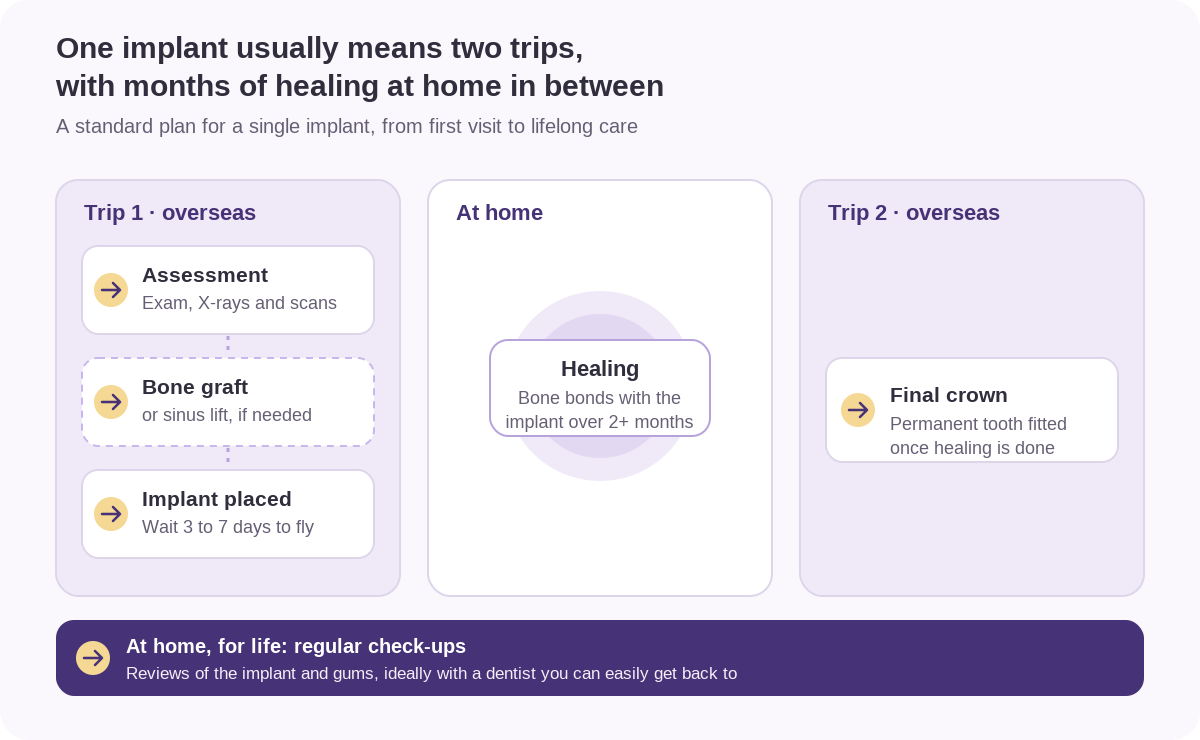
The bone needs time to bond with the implant (osseointegration). With the standard approach, the permanent tooth is fitted more than 2 months after placement [5]. Faster “same-week” options exist for some cases, but they’re less well proven [6], so ask any clinic exactly how many visits your plan needs. After surgery, a 2023 review advises waiting at least 3 days before flying, ideally a week, and at least 2 weeks after a sinus lift, ideally 6 [7].
Cost and travel factors
Looking for a free implant consultation in Australia?
Find an implant consultationUpfront cost versus total cost
The implant fee is only one part of the budget, and a second trip doubles the travel costs. If something goes wrong, fixing it can cost more, travel insurance may not cover it, and Medicare doesn’t cover you overseas [2].
Thailand clinic prices vary by implant system and by what the package includes. Published single-tooth packages with an implant, abutment and crown range from about A$1,560 to A$4,670 before travel [15][17][18][19][20][21].
A cheaper clinic fee can still mean a higher total bill
For one implant, travel and accommodation can outweigh the upfront saving.
Thailand
Published clinic prices
- Implant, abutment and crown
- A$1,560–A$4,670
- Consultation and 3D scan allowance
- A$110–A$425
- Return flights for two trips
- A$1,800–A$2,800
- Accommodation for 10 nights
- A$700–A$1,300
Estimated total with travel
A$4,170–A$9,200
Australia
Dental Match 2026 pricing research
- Implant, abutment and crown
- A$2,799–A$7,350
- Consultation and scans
- Included in the research range
- Travel to treatment
- Not needed
- Overnight accommodation
- Not needed
Treatment estimate, local care
A$2,799–A$7,350
Average treatment price: A$4,827
Thailand figures are an illustrative budget for two return economy flights from Sydney, 10 nights in Bangkok and a consultation and scan allowance. Clinic inclusions vary, so check whether an exam, X-ray or 3D scan is already in your quote. Additional procedures, meals, local transport, time off work and complications are excluded.
By comparison, Dental Match’s 2026 pricing research found that a single dental implant in Australia costs between A$2,799 and A$7,350, with an average of A$4,827. The Australian range includes the consultation, scans, implant, abutment and crown [8].
The headline treatment price in Thailand can look much cheaper than the Australian price. But once you add flights and accommodation for the visits treatment may require, the overall cost of a single implant can be higher, particularly when the local treatment price is at the lower end of the Australian range. Travel is a large fixed cost for one tooth. It may be spread across several implants when a treatment plan involves more teeth, but your total still depends on the care you need and how many trips are required.
For a single implant, this estimate puts Thailand’s treatment and travel total at A$4,170–A$9,200, compared with A$2,799–A$7,350 for the Australian treatment range. The estimates overlap, but the added travel means an overseas clinic’s lower headline fee does not automatically make the full treatment cheaper.
Additional procedures, such as bone grafting, and complications or follow-up treatment can increase costs in either country.
For the full breakdown of Australian prices [8], read our guide to dental implant costs in Australia.
Making treatment more affordable at home
- Private health extras. Check what your extras pay for major dental work, your annual limits and any waiting periods, which can run to 12 months or more for major items [9].
- Payment plans and public clinics. Ask about payment plans, and check whether you’re eligible for treatment at a public dental clinic [1].
- Superannuation. Early release of super may be allowed in limited circumstances, when there’s no other way to pay [10]. Read our guide to accessing super for dental treatment.
Before you book
Tell your private health and travel insurers about your plans, even if they won’t cover the procedure, and see your doctor at least 6 weeks before you travel [2]. An Australian dentist can also review the overseas plan and give you a local quote to compare.
How to check an overseas dentist’s credentials
Smartraveller recommends checking both the dentist and the clinic before you commit [2].
- Get their details. Ask for the dentist’s full name, qualifications and registration number.
- Look them up. Search the country’s official dental register. Most countries publish this on an official website.
- Check the clinic. Confirm it’s accredited by the local health authorities, and avoid unofficial facilities.
- Ask about insurance. Make sure the dentist and clinic hold indemnity and malpractice insurance.
- Read past patients’ experiences. Look for reviews beyond the clinic’s own website.
- Compare the risks they quote. Be wary if a clinic claims much lower complication risks than an Australian dentist would.
Questions to ask the clinic
- Which implant brand and system will you use, and will I get the details in writing?
- How many visits will I need, and how long between placement and the final crown?
- When will it be safe for me to fly home?
- How do you sterilise instruments and control infection?
- Can I have a written, itemised quote covering scans, any bone graft, the implant, the crown, temporary teeth and follow-up visits?
- If something goes wrong after I’m home, who fixes it and who pays? Does any guarantee cover return travel or repairs by another dentist?
- Can I take copies of my X-rays, scans and treatment plan?
Next step: compare with a local quote
The surest way to judge an overseas offer is to put it beside a detailed local one. Book a consultation through Dental Match for a written, itemised implant quote and treatment plan, with follow-up care close to home.
Cost estimate assumptions
All amounts in this article are shown in Australian dollars. Thai clinic prices were converted using the Reserve Bank of Australia’s reference exchange-rate data for 24 November 2026; the rate is not reproduced here [16]. The consultation and scan allowance is modelled from Bangkok Hospital’s published fees. Totals are illustrative, rounded to the nearest A$10, and exclude additional procedures, meals, local transport, time off work and complications [22][8].
Further reading
These independent Australian resources are worth reading before you commit to treatment overseas.
- Smartraveller: Going overseas for a medical procedure covers choosing a destination, clinic and dentist, plus insurance and what the government can and can’t do.
- Dental Board of Australia: Tips for dental patients explains how to check a dentist’s registration and what good infection control looks like.
- Ahpra: How to raise a concern shows where to go if something goes wrong with an Australian practitioner.
Sources checked 25 November 2026. This article is general information, not personal dental advice.
Sources and further reading
- Australian Institute of Health and Welfare: Oral health and dental care in Australia
- Smartraveller: Going overseas for a medical procedure
- Dental Tribune International: Dental tourism among UK patients is on the rise, BDA reports
- Dental Tribune International: The steady rise of dental tourism and the risks of cheap treatment abroad
- Schrott et al.: Implant loading protocols for partially edentulous patients with extended edentulous sites
- Gallucci et al.: Implant placement and loading protocols in partially edentulous patients
- Felkai et al.: Dental tourism and the risk of barotrauma and barodontalgia
- Dental Match: Dental implant costs in Australia
- PrivateHealth.gov.au: Waiting periods
- Dental Board of Australia: Using your superannuation for dental treatment
- Esen et al.: Deep learning-based identification of dental implant systems from two-dimensional radiographs
- Derks and Tomasi: Peri-implant health and disease
- Dental Board of Australia: Tips for dental patients
- Therapeutic Goods Administration: Implantable devices
- Smile and Shine Dental Clinic: Dental implant price list
- Reserve Bank of Australia: Exchange rates
- HeySmile Dental Clinic: Dental prices in Bangkok
- Bangkok Hospital Pattaya: Dental implants with crown package
- Kitcha Dental Clinic: Dental prices
- Smile Signature Dental Clinics: Fees
- Thantakit International Dental Center: Dental implant prices in Thailand
- Bangkok Hospital Headquarter: Dental treatment fees
- KAYAK: Sydney to Bangkok flights
- Booking.com: Bangkok accommodation listings