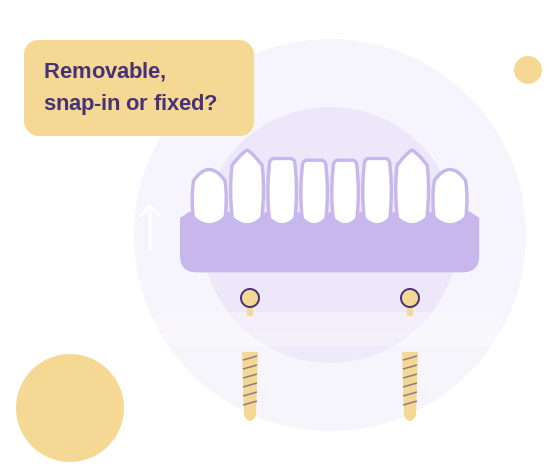
For many people, moving from loose removable dentures to snap-in dentures held by implants makes a big difference to chewing, comfort, speech and satisfaction, according to a review of 26 studies [1]. Fixed and snap-in implant options seem to make about the same difference [2], so the biggest change comes from adding implants at all.
There are three main options: removable dentures that you take out each day, snap-in dentures that click onto implants but still come out, and fixed dentures that are anchored to implants and stay in your mouth. This guide compares what they cost in Australia, how to look after them, and how they change eating, appearance and breath.
The difference in a nutshell
The main difference is how the teeth stay in place: removable dentures rest on your gums, while fixed dentures are screwed onto implants in your jawbone.
Removable dentures are false teeth set into a gum-coloured base. A full denture replaces all the teeth in your upper or lower jaw and rests on your gums. A partial denture fills gaps and clips onto your remaining natural teeth. You take them out to clean them and usually leave them out overnight.
Fixed dentures (also called implant-supported bridges or "All-on-4" style teeth) are a full row of teeth attached to several dental implants. An implant is a small screw, usually made of titanium, that is placed in the jawbone in place of a tooth root [3]. Fixed dentures stay in your mouth, and only your dentist can take them out.
There is also a middle option: implant-retained overdentures, sometimes called "snap-in" dentures. These are removable dentures that click onto implants, often two in the lower jaw [1]. People rate them as more stable than ordinary dentures [1], but they still come out for cleaning.
Missing only a few teeth? A partial denture replaces some teeth and is held in place by small metal clasps around your remaining natural teeth [4]. It costs about $750 to $2,800 (2025 prices) [5]. Another option is an implant with a crown for each missing tooth. Dental Match's 2026 pricing research puts this at $4,827 per tooth on average (ranging from $2,799 to $7,350 for a straightforward case), including the consultation, scans, implant, abutment and crown. For the full breakdown, read How much does a single dental implant cost in Australia in 2026? This guide focuses on replacing a full set of teeth, but the care advice for removable dentures applies to partials too.
How do they change everyday life?
Research finds that snap-in dentures held by implants improve chewing, comfort and satisfaction more than ordinary removable dentures [1], and that fixed and snap-in options perform about the same [2].
Eating
Dentures can make eating easier if you have missing teeth, although it is best to start with soft foods while you adjust [4]. Because ordinary dentures rest on the gums, people rate them as less stable than snap-in dentures held by implants [1].
Anchoring them to implants makes a clear difference. A review of 26 studies found that people whose lower denture was held by two implants chewed significantly better than people with ordinary dentures. They also rated their dentures higher for comfort, stability, speaking and chewing [1].
When fixed dentures were compared with snap-in overdentures, there was no clear overall winner. Fixed dentures came out slightly ahead in most studies, but results for chewing were mixed [2].
Appearance
When missing teeth are not replaced, the muscles in the face can sag, and dentures can help fill out your face [4].
Breath
Bad breath can affect people with removable or fixed dentures, but research has found it tends to be worse with removable ones [6]. In more than 80% of cases, bad breath comes from bacteria in the mouth. A denture that isn't cleaned well becomes a home for those bacteria [6].
Wearing removable dentures overnight is linked to higher levels of the sulphur gases that cause bad breath, and fixed bridges can trap food and plaque if they are hard to clean [6]. Good cleaning of your mouth and denture, and taking removable dentures out at night, both help reduce it [6]. The daily routines later in this guide will help keep your breath fresh.
Confidence and overall wellbeing
Dentures of any kind can help you feel more confident [4]. Snap-in dentures tend to go further: people whose lower denture clicks onto two implants rate their overall satisfaction, and their quality of life as it relates to their mouth, higher than people with ordinary dentures [1].
What do they cost in Australia?
Removable dentures usually cost a few thousand dollars per jaw, while fixed dentures usually cost several times more because of the implants.
A 2025 price check of dentists and denture clinics around Australia found full dentures cost about $2,000 to $5,000 per jaw [5]. These figures cover the denture itself, not consultations, follow-up visits or extractions.
Implant options cost more because the implants are charged on top. According to the Australian Dental Association's most recent fee survey, as reported by Canstar in 2026, placing one implant costs about $2,250 ($2,702 with a specialist) and the connector piece (abutment) that sits on top about $880 ($1,010 with a specialist), so roughly $3,100 to $3,700 per implant before any teeth are attached [7]. The same 2025 price check put implant-supported dentures at about $4,000 to $8,000 per jaw, for the denture only [5].
Estimated cost per jaw by option
AUD. Snap-in and fixed are Dental Match estimates that add implant fees to the denture price.
- Partial removable denture
- $750 to $2,800
- Full removable denture
- $2,000 to $5,000
- Snap-in overdenture
- $10,300 to $15,400
- Fixed denture
- $16,500 to $30,300
Sources: Canstar 2025 price check [5]; implant fees from the ADA fee survey as reported by Canstar 2026 [7]
| Option | Estimated cost per jaw |
|---|---|
| Partial removable denture | $750 to $2,800 (2025 prices) [5] |
| Full removable denture | $2,000 to $5,000 (2025 prices) [5] |
| Snap-in overdenture | about $10,300 to $15,400* |
| Fixed denture | about $16,500 to $30,300* |
*Dental Match estimates using 2025 denture prices [5] and implant fees reported in 2026 [7], assuming 2 implants for a snap-in denture and 4 to 6 for a fixed denture: about $3,100 per implant, or about $3,700 if a specialist places them, plus about $4,000 to $8,000 for the denture. Extractions, bone grafts, scans, sedation and premium materials can push the total higher, so always ask for a written, itemised quote.
What about over 10 years? Removable dentures usually need replacing every 3 to 5 years [5]. Over 10 years, that can mean two to four sets, or roughly $4,000 to $20,000 per jaw for full dentures at 2025 prices [5]. Studies often report that more than 90% of fixed dentures are still working after 10 years [8], so the cost gap narrows over time, although repairs to fixed dentures add to the bill.
Cost per jaw over 10 years
AUD at 2025 prices, before repairs to either option
- Full removable, 2 to 4 sets
- $4,000 to $20,000
- Fixed denture, one set
- $16,500 to $30,300
Sources: Canstar 2025 [5]; Dental Match estimate for fixed dentures [5] [7]; 10-year durability [8]
Will insurance help? Medicare generally does not cover dentures. Private health insurance with "major dental" extras cover may pay part of the cost, usually after a waiting period of around 12 months and with limits on how often a denture can be replaced. Eligible concession card holders may be able to get dentures through public dental services, depending on their state or territory [5].
How long does it take?
Removable dentures can be ready within several appointments [4], while implant options take longer because the bone needs time to grow around the implants [3].
Removable dentures. Each denture is custom-made, and making and fitting it often takes several appointments. If you are having teeth removed, you can choose an immediate denture, fitted on the same day so you are not left without teeth. Your dentist may instead suggest waiting a few months for your gums to heal first, so you need fewer adjustments later [4].
Snap-in and fixed dentures. These start with surgery to place the implants. Treatment is usually done in stages over a few months, because the bone takes about 3 months to grow around each implant before your final teeth are attached [3]. Ask your dentist for a personal timeline, as yours will depend on your jawbone and any other treatment you need first.
- Implant surgery
- Healingabout 3 months
- Final teeth fitted
Worried about pain? Our guide, Do Dental Implants Hurt? What to Expect Before, During and After, explains what happens during and after implant surgery.
Aftercare and maintenance
All three options need professional upkeep: removable dentures need adjusting as your mouth changes, fixed dentures need regular checks of the screws, teeth and implants, and snap-in dentures need a bit of both.
Removable dentures
Expect a settling-in period. It can take a few months to get used to new dentures. At first they may feel loose or awkward, rub and cause sore spots, or make you produce more saliva. Starting with soft foods helps, and a few follow-up visits are normal so your dentist or dental prosthetist (a denture specialist) can adjust the fit as your gums heal [4].
Fit checks. Your dentist or dental prosthetist should check the fit at least once a year and may need to adjust it [4]. Dentures usually need replacing every 3 to 5 years [5]. See your dentist sooner if your mouth is sore or you notice bleeding gums, swelling or ulcers [4].
Snap-in dentures
Like any removable denture, the denture part may need adjusting from time to time, and its fit should be checked at least once a year [4]. Like fixed dentures, the implants and the gums around them need regular check-ups, and any swelling or inflammation should be looked at quickly [3]. At these visits your dentist also checks the small attachments that hold the denture onto the implants.
Fixed dentures
Healing comes first. For two to three weeks after implant surgery, you will usually eat soft foods and use mouthwash around the implants instead of brushing them [3].
Small repairs are part of normal life. Fixed dentures are very durable: research generally reports that more than 90% are still working after 10 years. Even so, recurring repairs are common. Screws can loosen or break, the teeth can wear or chip, and the gums and bone around the implants can develop problems, including inflammation and bone loss [8]. This is why ongoing check-ups matter as much as the original surgery.
Home care: your daily routine
Removable and snap-in dentures come out to be cleaned, while fixed dentures are cleaned in your mouth like natural teeth, with a few extra tools to reach underneath.
Removable dentures (including partials)
- Brush them, out of your mouth, at least twice a day. Clean every surface with a soft toothbrush and mild soap and water, in the morning, before bed and after meals when you can. Skip toothpaste, as it can scratch the surface [4].
- Don't rely on soaking alone. In one study, soaking dentures for 5 minutes a day in a sodium perborate cleaning tablet had no effect on the germs living on the denture and did not reduce the sulphur gases that cause bad breath [6].
- Brush your gums and tongue every day, even if you have no natural teeth left [4].
- Take them out at night. This gives your gums a rest. Store them in a clean, dry container overnight [4].
Snap-in dentures
Follow the removable denture routine above. Also clean around each implant in your mouth twice a day, using a soft toothbrush or a small interdental brush [3].
Fixed dentures
- Brush your teeth and gums twice a day, just as you would natural teeth [3].
- Clean underneath and around each implant with floss, small interdental brushes or a water flosser [3]. This step matters most, because the shape of a fixed bridge can make it hard to reach plaque that builds up underneath [8].
- Clean your tongue daily, as a coated tongue is linked to the sulphur gases that cause bad breath [6].
Removable dentures and oral thrush
Wearing a removable denture increases the risk of oral thrush, because the denture gives yeast a sheltered surface to grow on. It often shows up as denture stomatitis, and estimates vary, but it affects about one in three denture wearers [9].
What is it? A yeast that normally lives in your mouth builds up on the underside of your denture and makes the gums underneath red and inflamed. It usually affects the roof of the mouth under an upper denture, and many people feel no pain at all [9].
Why is it more likely with removable dentures? A removable denture sits directly on your gums, and an upper one covers the roof of your mouth. This traps yeast against the gums and reduces the flow of saliva, which normally rinses your mouth, underneath the denture. The plastic (acrylic) base is also slightly porous, so yeast can cling to it [9].
Wearing the denture overnight, a loose fit that rubs your gums, poor cleaning, smoking, a dry mouth and poorly controlled diabetes all add to the risk [9].
Signs to look for: red or swollen gums where the denture sits, soreness or burning, a bad taste, or cracked corners of the mouth [9].
What to do: see your dentist, who may prescribe an antifungal gel and check that your denture still fits. To stop it coming back, stick to the daily routine above, especially taking your dentures out at night [9].
How often do they need checks or replacing?
Removable dentures need a check at least once a year and replacing every few years, while fixed dentures often last 10 years or more [8] but need ongoing check-ups.
| Removable dentures | Fixed dentures | |
|---|---|---|
| Dental check-ups | At least once a year, to check the fit [4] | Regular check-ups on a schedule your dentist sets [3] |
| Typical lifespan | Usually replaced every 3 to 5 years [5] | Often reported as more than 90% still working after 10 years [8] |
| Common repairs | Adjustments and fit checks [4] | Tightening or replacing screws, fixing chipped or worn teeth |
Snap-in dentures need both: the implants are checked like fixed dentures, and the denture part is adjusted and eventually replaced like a removable one. There is no single agreed check-up schedule for implant-held teeth [8], so ask your dentist how often you should come in. At these visits, they check the implants, the gums around them, the screws or attachments, and the teeth.
If you have private health insurance, check your policy's replacement limits before getting a new denture. Some funds only cover one upper and one lower denture every three to five years [5].
Which is right for you?
Removable dentures suit people who want the lowest cost and no surgery, while implant options suit people whose loose dentures are affecting their eating, speech or confidence.
| Removable denture | Snap-in overdenture | Fixed denture | |
|---|---|---|---|
| Cost | Lowest | Middle | Highest |
| Surgery needed | No | Yes, to place implants | Yes, to place implants |
| Stability when eating | Can move | More stable, clicks into place | Fixed in place |
| Daily cleaning | Take out and brush | Take out and brush, clean around implants | Brush in place, clean underneath with special tools |
| Out at night | Yes | Yes | No, only your dentist can remove it |
Implants are not suitable for everyone. Smoking, diabetes, gum disease, osteoporosis and some other health conditions raise the risk of complications, so your dentist will check your health and jawbone first [3].
The best next step is to talk with a dentist or prosthodontist (a dentist who specialises in replacing teeth) about your options. Ask for a written, itemised quote for each one, and check what your health fund will cover before you decide.
Fill in the Dental Match booking form and the Dental Match team will call you back.
Go to the booking formSources
- [1] Kutkut et al. 2018, Journal of Prosthodontic Research: A systematic review of studies comparing conventional complete denture and implant retained overdenture (accessed 2026-11-24)
- [2] Yao et al. 2018, Clinical Oral Implants Research: Patient-reported outcome measures of edentulous patients restored with implant-supported removable and fixed prostheses (accessed 2026-11-24)
- [3] healthdirect Australia: Dental implant procedure (accessed 2026-11-24)
- [4] healthdirect Australia: Dentures (accessed 2026-11-24)
- [5] Canstar: How much do dentures cost? (accessed 2026-11-24)
- [6] Wyszyńska et al. 2021, Journal of Clinical Medicine: The problem of halitosis in prosthetic dentistry, and new approaches to its treatment (accessed 2026-11-24)
- [7] Canstar: Compare health insurance with dental cover (Australian Dental Association fee survey figures) (accessed 2026-11-24)
- [8] Norré et al. 2026, International Journal of Prosthodontics: Complications in full-arch implant-supported restorations during the maintenance phase (accessed 2026-11-24)
- [9] Abuhajar et al. 2023, International Journal of Environmental Research and Public Health: Management of chronic atrophic candidiasis (denture stomatitis) (accessed 2026-11-25)